
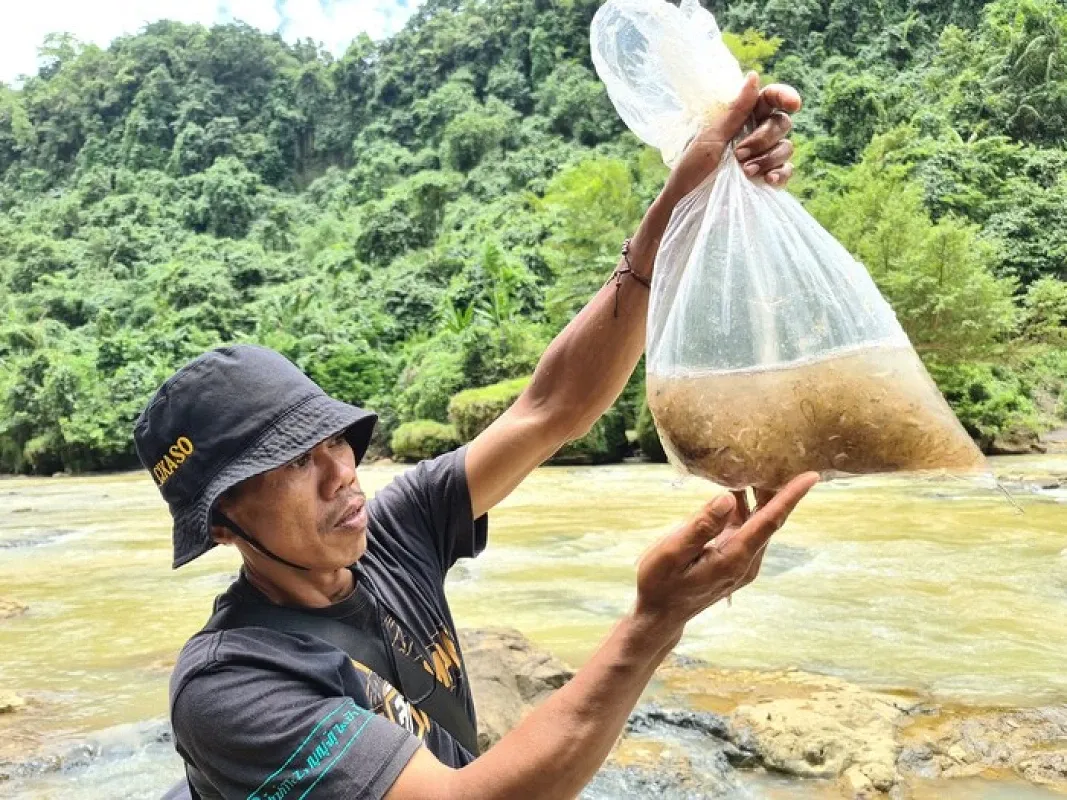
By JAIF Management Team
Tropical Anguillid Eels – vital for local livelihoods and international trade in the ASEAN region – face sustainability risks due to insufficient fundamental scientific data. Specifically, the trends in stock abundance, distribution, and structure of these species remain largely unknown, preventing ASEAN Member States (AMS) from determining safe allowable catch limits. The six-year project "Development of Stock Assessment Methods and Strengthening of Resources Management Measures for Tropical Anguillid Eel in Southeast Asia" (2020-2026), funded by the Japan-ASEAN Integration Fund (JAIF) and led by the SEAFDEC Secretariat, is a crucial regional effort to address these gaps. Building on Phase 1 (2017-2019), Phase 2 focuses on developing robust stock assessment methods and harmonising data collection across AMS to ensure sustainable eel fisheries through the long-term collaboration on Tropical Anguillid Eels management. Specifically, the project supports AMS in systematically collecting catch data and biological information, and in developing mathematical and statistical methods for stock estimation, enabling effective management measures for sustainable fisheries of Tropical Anguillid Eels. This is particularly urgent given that the listing and export restrictions on other global eel species have potentially increased the exploitation pressure on Tropical Anguillid Eels.1

Fishers checking eel traps from a small boat in Cimandiri River.
©SEAFDEC Secretariat
Voices from the field were collected from the focal points across the region and the Implementing Agency sharing key takeaways from the project.

Testimonial from
Dr. Evelyn C. Ame
a Career Scientist and Training Superintendent at the Bureau of Fisheries and Aquatic Resources, the Philippines
The result of the project can be a basis for policy formulation for our eel resource management. So that, we can tell people not to abuse the resources, manage it rightly and to curb the illegal trade of glass eels.
-converted.webp)
Dr. Ame on the right with her colleague from the Philippines at the Project End Meeting in Bangkok, Thailand, October 2025.
©SEAFDEC Secretariat
Evelyn C. Ame highlighted that her country's biggest problem in eel management is the smuggling or illegal trade of glass eel or transparent juvenile eel, which is believed to be depleting resources. The most useful thing she learned was the stock assessment tools presented, particularly the mathematical equation developed by an expert from Tokyo University of Marine Science and Technology. This method allows for assessing the status of the difficult-to-measure glass eel fishery. She hopes to use these results to develop new laws or ordinances necessary to effectively manage national eel resources and curb illegal activities.

Testimonial from
Prof. Dr. Eko Sri Wiyono
a Lecturer/Researcher at IPB University (Bogor Agricultural University), Indonesia
Indonesia is an archipelagic country where approximately 66% consists of marine waters, so the difficulty is in management of eels in small-scale fisheries spread across different parts of Indonesia.
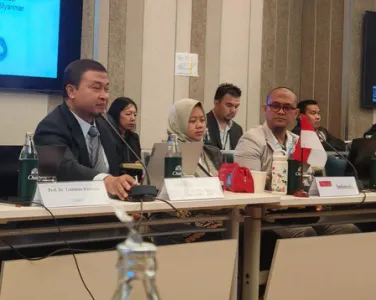
Dr. Eko on the left and Mr. Dony on the right with the representative from Indonesia.
© SEAFDEC Secretariat
Eko Sri Wiyono noted the significant challenge posed by Indonesia's vast geography with numerous islands and scattered small-scale fisheries, making data collection and management difficult. His most memorable experience was discussing with experts from abroad and determining the model for stock assessment of Anguillid Eel. The project inspired him to develop new models for fish fisheries with similar behavior to eels, and he plans to apply and disseminate these findings to his students on campus.
Testimonial from
Mr. Dony Armanto
Ministry of Marine Affairs and Fisheries, Indonesia
We need more capacity building in the whole of Indonesia, especially for eel fishermen and district government to upscale their capacity to increasing participation and knowledge for support of resource management in Indonesia.
Dony Armanto pointed to the lack of capacity among fishermen to make the eel business sustainable as the biggest difficulty in his country. For him, the most useful thing learned was the identification of glass eel using methods like DNA sequencing and a fast fluorescent light method, which is a fast technique that doesn't require laboratory equipment. He believes there is a need for more capacity building across Indonesia, especially for eel fishermen and district government, to increase participation and knowledge for resource management.
Testimonial from
Dr. Phuc Dinh Phan
Deputy Head of the Research Institute for Aquaculture, Viet Nam
The knowledge from the project is very helpful for me and our country to learn how to assess the stock and identify capture fishery of the Anguillid Eel. I can apply the knowledge to enhance and protect the Anguillid resources in our country.
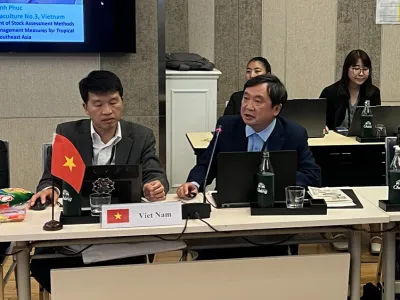
Dr. Phuc on the right presenting the situation in Viet Nam with his colleague in the meeting.
© SEAFDEC Secretariat
Phuc Dinh Phan identifies the primary challenges in managing eel resources in Viet Nam are the difficulty in controlling glass eel capture from natural waters and the insufficient enforcement of relevant fishing laws, contributing directly to overfishing concerns. He views the knowledge acquired from the project as highly instrumental for national conservation efforts. This expertise encompasses methodologies vital for stock assessment, species identification, and the sustainable governance of the Anguillid Eel capture fishery. He plans to strategically implement this knowledge nationally to strengthen and safeguard the Anguillid Eel resources within Viet Nam.
Testimonial from
Ms. Ni Komang Suryati
the JAIF-Eel Project Activity Leader from SEAFDEC/Inland Fishery Resources Development and Management Department (IFRDMD), Indonesia
Among the many achievements during six years, we successfully developed the idea of regional standard method for monitoring eel resources, which can be applied consistently across the ASEAN Member States.
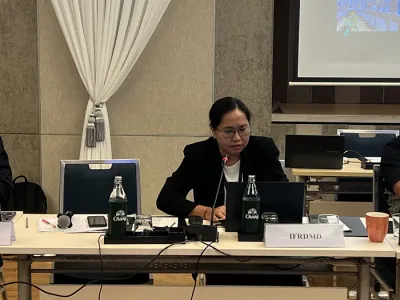
Ms. Komang presenting the findings of SEAFDEC/IFRDMD in the meeting.
© SEAFDEC Secretariat
Ni Komang Suryati, representing the Implementing Agency, cited the biggest challenge was harmonizing data and methodologies across the AMS, given the unique environmental and fishing practices. The project's most substantial accomplishment was the conceptualization and development of a regional standard methodology for monitoring shared eel resources. This will enable resource assessment to be applied consistently and uniformly across AMS. Furthermore, she highlighted the most practical lesson learned was the critical importance of ensuring that scientifically rigorous stock assessment methods are also operationally feasible for consistent application by local field enumerators and fishers.
The collaboration fostered by this project has equipped AMS with essential tools and knowledge to advance beyond the initial stage of eel resource management. From developing scientifically sound stock assessment methodologies to fostering regional cooperation and strengthening local capacity for glass eel identification and data collection, the project has laid a solid foundation for the sustainable use and long-term conservation of Tropical Anguillid Eels in the ASEAN Region. This initiative demonstrates a long-term strategic vision of the Government of Japan through JAIF for cultivating resilient and sustainable agriculture and food systems across Southeast Asia. This commitment ensures the outputs directly contribute to future frameworks like the ASEAN Food, Agriculture and Forestry Sectoral Plan 2026- 2030 and the ASEAN-Japan MIDORI Cooperation Plan.
Sectors
Funding Framework
Related Beneficiaries' Voice

ASEAN Develops Capacities on Taxonomy for Agricultural Pests and Diseases
 28 August 2022
Narrowing the Gap through Strong Network and Mutual Trust among Universities in the Mekong Region
29 July 2021
ASEAN Develops Capacities on Taxonomy for Biodiversity Conservation
29 November 2019